
In Canada, the USMLE Counts Most After a US Residency
Doctors preparing for the USMLE often keep Canada in mind as a second country: it is next door, and its residency training follows a similar model. The first rule Canada sets for residency, though, is not about exams. To enter a Canadian residency through CaRMS, the national match, you must be a Canadian citizen or a permanent resident, with few exceptions. Canada's own exams are the MCCQE and the NAC, and in the residency criteria the USMLE stands in for the MCCQE in only four provinces. The door the USMLE opens wider is a later one. Since 2025, most provinces give a full licence to doctors who completed a US residency and hold American board certification, and in several of them the rules accept degrees from medical schools outside North America. This article sets out, as things stand on 23 November 2026, the ways into Canadian practice, Canada's exams, where the USMLE counts, CaRMS for international graduates, the route from a US residency, the assessments for doctors already in practice, English and French, and what the work pays.
1. Five ways into Canadian practice
A doctor who qualified abroad can reach Canadian practice in five main ways. Which one fits depends less on your exams than on your immigration status and how far your training has gone.
| Route | Who it fits | What it asks for |
|---|---|---|
| Canadian residency (CaRMS) | Graduates who are already Canadian citizens or permanent residents | MCCQE and NAC passes (four provinces accept the USMLE for the MCCQE), English or French, and in most provinces a return-of-service contract |
| US residency, then Canada | Doctors who train in the US after the USMLE and the Match | An ACGME-accredited residency and American board certification; a full licence in most provinces, other terms in Ontario and Quebec |
| Practice-ready assessment | Doctors already practising abroad, mostly in family medicine | An assessment of about 12 weeks in most programs, then usually three years of service where the province needs doctors |
| Specialist from an approved jurisdiction | Specialists trained in Australia, New Zealand, Hong Kong, Singapore, South Africa, Switzerland, the UK or Ireland | Royal College assessment; specialists from elsewhere take the Practice Eligibility Route (exam, then two years of supervised practice in Canada) |
| Sponsored visa trainee | Residents funded by their own government, mostly from the Gulf | Arranged outside CaRMS between the sponsor and the university; the sponsor pays the salary |
On our reading, the table is lopsided for most readers of this site. Japan, Korea, Taiwan, Spain, Mexico, Saudi Arabia, Egypt and the UAE are not on the Royal College's or the College of Family Physicians' lists of approved jurisdictions. Without permanent residency, CaRMS is closed in almost every case. That leaves practice-ready assessment for experienced family doctors (Ontario's requires permanent residency), a sponsored post for Gulf trainees, and, for everyone else, the route through a US residency.
2. Canada's exams: the MCCQE and the NAC
The MCCQE
The Medical Council of Canada Qualifying Examination was called the MCCQE Part I until April 2026, when it was renamed the MCCQE. Older guides and prep sites still describe clinical decision-making cases, but those were removed in April 2025. It is now 230 multiple-choice questions in two sections of 115, each 2 hours 40 minutes, within a 6.5-hour appointment. Scores run from 300 to 600 and the pass mark is 439; scores from before 2025 are on a different scale and cannot be compared.
- Who can take it: graduates and students of a medical school listed in the World Directory of Medical Schools with a Canada Sponsor Note, as well as Canadian schools and US osteopathic schools. Students may apply up to 15 months before graduation. The listings for Seoul National University, Juntendo University and National Taiwan University that we checked on 23 November 2026 all carry the note; check your own school's listing.
- Where and when: at Prometric centres in Canada and in over 70 countries, four times a year. The 2027 sessions are 19 January to 11 February, 21 April to 8 June, 10 August to 7 September and 5 to 26 October; booking opens five months ahead and is first come, first served. The MCC publishes no list of countries, so check Prometric's seat search for your city. Remote proctoring has not been offered since the August 2026 session.
- Fee and attempts: C$1,500 (about US$1,046), paid in Canadian dollars. You have four attempts, with a one-year wait before the fourth, and you cannot retake it after a pass.
- Results: four weeks after the last day of the January, August and October sessions, five weeks after the April session.
The NAC examination
The NAC is a half-day objective structured clinical examination (OSCE): 12 stations of 11 minutes, two of them unscored pilots, in English or French. It is still running. The next session is on 1 May 2027, with applications open from 18 November to 9 December 2026, in Edmonton, Winnipeg, Hamilton, London, Ottawa (in French), Toronto, Windsor and Saskatoon, and in Dublin. The fee is C$3,320 (about US$2,315), and C$1,500 more for Dublin. Scores run from 500 to 700, the pass mark is 577, and you have three attempts, not in consecutive sessions. CaRMS's criteria ask international graduates for it in every province (in Quebec, it is the medical schools rather than the regulator that require it), and several practice-ready assessment programs ask for it too.
The LMCC and source verification
The Licentiate of the Medical Council of Canada (LMCC) is the credential many provinces list for full licensure. Since 26 January 2026 it no longer needs 12 months of postgraduate training: an acceptable medical school, an MCCQE pass and a medical degree verified through the MCC are enough, and for candidates who applied for the MCCQE on or after that date, it is issued automatically and without a fee. Verification goes through physiciansapply.ca: C$150 to open an account and C$232 for each credential, with documents sent through ECFMG to your school, which the MCC warns can take three months or longer. Documents not in English or French must be translated by one of three companies the MCC names.
3. Where the USMLE counts in Canada
The MCC's own pages on the MCCQE and the LMCC do not mention the USMLE. It appears instead in the rules of particular provinces and programs:
- Residency (CaRMS). In the criteria CaRMS shows for the 2026 match, Nova Scotia, New Brunswick and Prince Edward Island accept USMLE Steps 1 and 2 in place of the MCCQE, and Saskatchewan accepts Steps 1, 2 and 3. No province lists the USMLE in place of the NAC, and the citizenship rule still applies.
- Licensure. Nova Scotia and Newfoundland and Labrador accept USMLE Steps 1, 2 and 3 as an alternative to the LMCC. Saskatchewan accepts the US licensing examinations its council considers acceptable in place of the MCCQE.
- Ontario's US route asks for the USMLE or an acceptable alternative, together with US training, board certification and a US licence or eligibility for one.
- Quebec. The restrictive permit for US-trained specialists requires all three Steps. The clinician restrictive permit, a separate route with a 12-week evaluation, accepts USMLE Step 2 CK as its exam.
- Sponsored trainees. McGill University's postgraduate office, which takes residents sponsored by Bahrain, Kuwait, Oman, Qatar, Saudi Arabia and the UAE, accepts MCCQE results and/or USMLE Steps 1 and 2.
On our reading, Steps 1 and 2 on their own stand in for a Canadian exam in only a few places. Where the USMLE carries real weight is as the entry to US training, which several provinces now accept in place of their own.
4. Canadian residency through CaRMS
CaRMS's basic eligibility rule for the R-1 match, for Canadian and international graduates alike, is that you be a Canadian citizen or a permanent resident of Canada. CaRMS adds that "some exceptions may apply"; the main one is in Quebec, for visa students already studying at a Quebec medical school. For an international graduate, the other conditions are:
- Exams: the MCCQE and the NAC, with the substitutes listed in section 3, and a Medical Identification Number for Canada.
- Streams: Ontario, British Columbia, Alberta, Manitoba, Saskatchewan (Royal College programs), Newfoundland and Labrador, and Nova Scotia with New Brunswick and Prince Edward Island set aside positions for international graduates in the first iteration. Quebec has no separate stream. British Columbia requires its Clinical Assessment Program first, Alberta its own IMG program, and Quebec recognition of your degree by the Collège des médecins.
- Prior training: anyone with previous residency training in Canada or an ACGME program cannot enter the first iteration, and a US preliminary year counts as training. Practising physicians cannot enter the first iteration anywhere; in the second iteration they can in five provinces.
- Recency: some programs turn away applicants who have been away from medical school, training or practice for a long time: more than three years at Memorial University in Newfoundland and Labrador, three years or more at Dalhousie University for Nova Scotia, New Brunswick and Prince Edward Island.
- Return of service: most provinces' IMG positions come with a contract to work in an underserved area after training. British Columbia asks for two years after family medicine and three after a Royal College specialty; Saskatchewan, year for year; Manitoba, a period matching the length of training; Alberta has none. Ontario's own pages disagree: its IMG page (updated 2 November 2026) says five years, while the ministry's guidelines say that from 2026 the obligation is 7,200 hours, at least 120 hours a month, outside Ottawa and the Toronto area.
Residents sponsored by their own government, called visa trainees, are outside CaRMS altogether. Provinces set how many there are, universities manage the places, and the foreign government pays the salary and training costs. IRCC says 2,797 work permits were issued to visa trainees in 2024, under the International Mobility Program and without a labour market impact assessment, and puts Saudi Arabia (1,668) and Kuwait (297) at the top of its list of the countries they come from. McGill University, which takes trainees sponsored by six Gulf states, asks them to commit to returning home.
The 2027 match runs on Eastern time. Applications close at noon on 26 November 2026; the national interview period is 16 January to 7 February 2027, although interviews for international graduates are arranged separately; rank order lists close at 15:00 on 18 February; and Match Day is 2 March 2027 at noon. The fee is C$301.60, which covers four programs, plus C$66.26 for each extra program and a one-time C$136.62 to verify a non-Canadian degree.
In the 2026 match, 931 international graduates matched over both iterations, up from 851 in 2025, CaRMS reports. Time since graduation went with very different results: 80% of international graduates who graduated that year matched, against 38% of those who had graduated more than three years earlier. The category itself has also grown: US MD graduates who graduated on or after 1 July 2025 now apply as international graduates, because the joint accreditation of US and Canadian schools ended.
5. From a US residency to a Canadian licence
In 2025, provinces began opening full licences to physicians trained in the US. The MCC reported that physiciansapply.ca accounts opened by US graduates rose 718% between November 2024 and April 2025, compared with a year earlier, and British Columbia says more than 210 US-trained and certified physicians registered there between 1 March 2025 and 31 January 2026. As of November 2026, the provincial rules read like this:
| Province | What US training and certification lead to |
|---|---|
| British Columbia | Full licence (since 7 July 2025) with ACGME training and ABMS board certification, or ABFM or AOBFP certification for family medicine. No LMCC or job offer needed, but no licence until you hold a work permit, permanent residency or citizenship |
| Alberta | General register (since 9 June 2025) with American board or AOA certification; MCC exams and practice-ready assessment waived |
| Saskatchewan | Regular licence with ABMS certification and a US licence or eligibility for one |
| Manitoba | Full licence (since 30 May 2025) with ACGME training, board certification and an independent US state licence |
| Ontario | Independent practice in your specialty under a restricted or provisional certificate, with the USMLE or an acceptable alternative and a US licence or eligibility for one; an independent practice certificate after five years of practice in Ontario. Board-eligible doctors within five years of residency may practise under supervision for up to three years |
| Quebec | Restrictive permit for specialists other than family physicians, in an institution, renewed yearly; needs all three USMLE Steps, 12 months of practice in the last three years, and French: proof of it, or at least an attempt at the language exam before the permit is issued |
| New Brunswick | Regular licence (since 1 January 2026) with training and certification from an approved jurisdiction, which includes the US, and 450 hours of practice in the last three years |
| Nova Scotia | Full licence with ACGME training, current ABMS or AOA certification and the LMCC or USMLE Steps 1 to 3, plus a job or privileges with Nova Scotia Health or the IWK Health Centre |
| Newfoundland and Labrador | Full licence (since 19 February 2026) with ACGME training, certification and the LMCC or USMLE Steps 1 to 3 |
| Prince Edward Island | Full licence, according to the MCC; the provincial college publishes no separate US route |
The question for a reader of this site is whether a medical degree from outside North America closes this route. In the rules we read, it does not. British Columbia asks for a degree from a school in the World Directory with a Canadian sponsor note, Alberta and Quebec for any school in the World Directory, and Nova Scotia for a school its council approves, which it defines the same way as British Columbia. Ontario's college merged its former route for "IMGs with US postgraduate training and certification" with the one for US and Canadian graduates in 2021, and its regulation accepts degrees from schools in the World Directory. Saskatchewan asks foreign graduates for English proficiency and verification of their degree, which on our reading means they are covered. The MCC's own summary does not address the point, so confirm it with the province you choose.
Two conditions are easy to miss. First, the route rests on board certification, not on finishing residency: British Columbia's route does not accept board-eligible doctors, and Ontario accepts them only under supervision. Second, ACGME-International is not ACGME. In British Columbia, doctors from ACGME-I programs, which run in the UAE, Qatar and Saudi Arabia among other countries, can get only a provisional specialty licence after passing the Royal College exam.
If you train in the US on a J-1, its two-year home residency requirement stays with you after you leave. Under US law it is met by living in the country of your nationality or last residence, so on our reading years in Canada do not count towards it unless Canada is one of those. It limits your return to live or work in the US (an H or L visa, or a green card), not your licence in Canada. Our article on residency visas explains the requirement.
The medicine does not stop at the border either. Blastomyces, the fungus behind the question below, lives in the US around the Great Lakes and the Saint Lawrence River, and in Canada as well, according to the CDC, and a study of 309 cases in Ontario from 1994 to 2003 found most of them in the north of the province.
A 38-year-old woman from northern Wisconsin is evaluated for a productive cough that began 7 weeks ago and an enlarging skin lesion on her forearm. She recently cleared rotting logs beside a lakeside cabin. Examination shows a painless verrucous plaque with small pustules along its raised border. Chest radiography shows a focal air-space opacity. She takes no immunosuppressive medications and reports no injury at the site of the plaque. A photomicrograph of a wet preparation of purulent material from the skin lesion is shown.
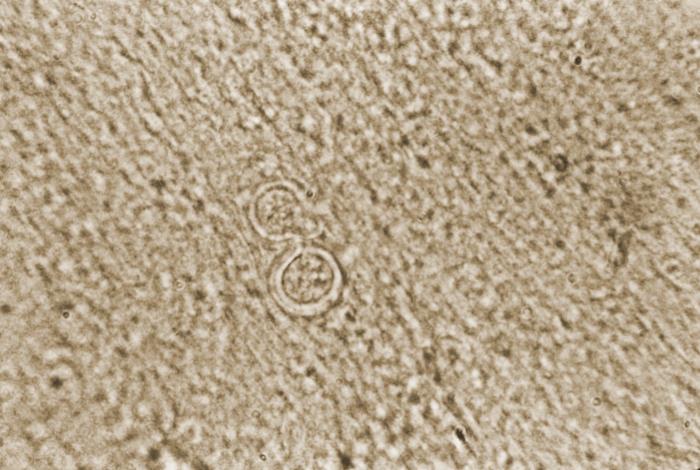
Which of the following processes most likely links this patient's pulmonary and cutaneous findings?
- Hematogenous dissemination of budding yeasts from an inhalational pulmonary infection
- Lymphatic extension of a fungal infection acquired through a skin puncture
- Translocation of commensal yeasts across a disrupted intestinal mucosal barrier
- Hematogenous dissemination of encapsulated yeasts following inhalation
- Hematogenous spread of weakly acid-fast branching bacteria following inhalation
- Contiguous spread of anaerobic filamentous bacteria across tissue planes
- Autoinfection by larvae that penetrate the intestinal wall
Show the answer and explanation
Answer: A
Seven weeks of productive cough with a focal opacity, a verrucous plaque with small pustules along its border, and recent work clearing rotting logs beside a lake in northern Wisconsin: this is blastomycosis that began in the lung and spread to the skin. The wet preparation shows a thick-walled yeast with a single broad-based bud. Blastomyces grows as a mold in moist soil and decaying wood; when that material is disturbed, its spores are inhaled, turn into yeasts at body temperature in the lung, and can reach the skin and bone through the bloodstream, even in people with normal immunity. So the skin lesion is not a separate inoculation but the same infection that started in the lung. Lymphatic spread after a skin puncture (B) is sporotrichosis, with nodules along the lymphatics and cigar-shaped yeasts. Yeasts crossing a damaged gut wall (C) describe invasive candidiasis, which forms pseudohyphae as well as buds. Encapsulated yeasts (D) are Cryptococcus, whose buds have a narrow base. Weakly acid-fast branching bacteria (E) are Nocardia. Anaerobic filaments spreading across tissue planes (F) are actinomycosis, with sulfur granules in the pus. Larvae that penetrate the bowel wall (G) cause Strongyloides hyperinfection. On the Canadian side of the lakes the fungus is the same: the CDC places it in Canada as well as the US, and a study from Ontario describes the northwest of the province as an area where the disease is endemic or hyperendemic.
Source: USMLE BANK / Pulmonary & Critical Care #8 Q12
Clues, then diagnosis, then mechanism.
Every USMLE BANK explanation starts with those three steps, then goes through each answer choice. The full bank opens in mid-December 2026; 10 questions are free to try now.
6. Already in practice: assessments and specialist routes
Practice-ready assessment
For doctors who finished training and have been practising abroad, most provinces run a practice-ready assessment (PRA): a supervised period of clinical work, usually 12 weeks, after which you are licensed on condition that you serve where the province needs doctors. Most are for family medicine.
- British Columbia (PRA-BC): family medicine. Two years of postgraduate training and two years of independent practice, at least 960 hours of practice in the last three years, and from 17 April 2026 an English test for every applicant. A 12-week assessment, then three years of service in BC.
- Saskatchewan (SIPPA): family medicine, 12 weeks, competitive, with the MCCQE, the NAC and an English test among its requirements. Under the agreement in force from 2026, a 36-month service commitment, with repayment of roughly C$225,000 to C$335,000 if it is not completed.
- Ontario (Practice Ready Ontario): family medicine, only for citizens and permanent residents, with the LMCC and 48 months of combined family medicine training and practice. A 12-week assessment, then three years in rural, northern or high-need communities. Health Canada announced on 7 October 2026 funding for 50 more places a year.
- Alberta: family medicine and specialists, with a sponsor through DoctorJobsAlberta. Two assessment stages of three months each; the college puts the whole process at about 37 weeks on average.
- Manitoba, Nova Scotia, New Brunswick and Newfoundland and Labrador run family medicine assessments too, and Manitoba and Nova Scotia also have tracks for specialists.
Specialists and family physicians
The Royal College of Physicians and Surgeons of Canada treats US training separately and keeps a list of approved jurisdictions whose specialist training it assesses directly: Australia and New Zealand, Hong Kong, Singapore, South Africa, Switzerland, and the UK and Ireland, each for particular specialties and dates. Specialists from anywhere else use the Practice Eligibility Route: you may sit the Royal College exam without practising in Canada first, but certification needs the exam plus two years of full-time supervised practice in Canada. For family medicine, the College of Family Physicians of Canada certifies without an exam doctors from Australia, Ireland, the UK and the US (ACGME training and ABFM certification) who are in active practice there.
7. English and French
The provincial colleges we checked share an English standard: IELTS Academic 7.0 in each part, OET Medicine grade B in each part, or CELPIP-General 9 in each part, taken within 24 months, usually in one sitting. TOEFL is not on their lists; in CaRMS, only Ontario accepts TOEFL iBT. Nova Scotia goes further: from 1 January 2027 it will list OET Medicine as its only test. Doctors who trained or practised in the US are often exempt. British Columbia, for example, exempts those who hold a licence and practise mainly in English in a country such as the US, and Alberta those whose medical school or postgraduate training was in a listed English-speaking country.
On our reading, the Canadian standard is stricter than ECFMG's in one place. ECFMG asks for 350, 350, 300 and 350 in OET Medicine; grade B in each part means 350 in Writing as well. A Writing score of 300 that is enough for ECFMG will not do for Canada.
In Quebec, French is the language of practice. Under section 35 of the Charter of the French Language, the Collège des médecins can issue a permit only to someone whose French is appropriate to the profession: for example, three years of full-time secondary or post-secondary education in French, or else a pass in the exam of the Office québécois de la langue française. Doctors trained outside Quebec can be given a one-year temporary permit while they work towards the exam, renewable up to three times.
8. Pay and immigration
Doctors' clinical work in Canada is paid mainly through the provincial health plans, and mostly by fee for service: 72% of clinical payments in 2023–24, according to CIHI. Its figures for that year, the latest we could check against CIHI's own tables, put the average gross clinical payment per physician at about C$383,000 (about US$267,000): about C$324,000 in family medicine, C$406,000 in the medical specialties and C$556,000 in the surgical specialties. CIHI stresses that these are gross payments and "do not represent physicians' net incomes": office rent, staff and other practice costs come out of them, and the College of Family Physicians cites an average overhead of 27% for family physicians and 22% for other specialties, from 2017. These numbers are not measured the same way as US salary surveys, so compare them with care with our article on US physician pay.
Canada relies on doctors trained elsewhere: in 2024, about 27% of its physicians had graduated abroad, from 8.3% in Quebec to 47.0% in Saskatchewan, CIHI's tables show. Immigration has followed:
- Work permits. A doctor nominated by a province or territory, with a full-time job offer, can get an employer-specific work permit without a labour market impact assessment, and IRCC aims to process it in 14 days if you apply online. Quebec has had a separate exemption since 31 July 2025 for physicians going to underserved regions.
- Permanent residency. Since December 2025, Express Entry has had a category for physicians with at least one year of Canadian work experience in the last three years. IRCC held three draws for it in 2026: 391 invitations on 19 February, 271 on 24 June and 229 on 3 September. The same announcement set aside 5,000 provincial nominee places for licensed doctors with job offers.
On our reading, the order matters. CaRMS needs permanent residency first, while the physician category in Express Entry needs Canadian work experience first. A doctor who arrives already licensed, from a US residency or a practice-ready assessment, can enter that sequence at the work permit; a new graduate cannot.
9. Choosing: questions to ask yourself
- Are you a Canadian citizen or permanent resident? If not, CaRMS is closed to you for now, and the routes that remain start from completed training.
- Where do you want to do your residency? If the answer is the US, the USMLE, the Match and board certification lead on to Canada as well, in most provinces without Canadian licensing exams. If you take a US preliminary year, remember that it shuts the first iteration of CaRMS.
- Can you finish US board certification? The Canadian routes are built on it, not on completing residency.
- Are you already a family physician? Practice-ready assessment is the route designed for you, often with Canadian exams (the MCCQE or the LMCC, sometimes the NAC) and a few years of service where you are placed.
- Is your OET Writing at 350? That, not ECFMG's 300, is the Canadian minimum. For Quebec, plan for French.
Frequently asked questions
Is the USMLE accepted in Canada?
In some places. For residency through CaRMS, Nova Scotia, New Brunswick and Prince Edward Island accept USMLE Steps 1 and 2 in place of the MCCQE, and Saskatchewan Steps 1 to 3; the NAC is still required. Nova Scotia and Newfoundland and Labrador accept Steps 1 to 3 as an alternative to the LMCC for licensure. The USMLE matters most as the entry to US residency, which several provinces accept for a full licence.
Can an international medical graduate apply to CaRMS without permanent residency?
Generally not. CaRMS requires Canadian citizenship or permanent residency for the R-1 match, with limited exceptions such as visa students already at a Quebec medical school. Residents sponsored by a foreign government are placed outside CaRMS.
Can I get a Canadian licence after a US residency if I went to medical school in Japan or Korea?
In the rules we read, yes, if you hold American board certification after an ACGME-accredited residency and your school is in the World Directory of Medical Schools with a Canadian sponsor note where the province asks for one. British Columbia and Nova Scotia accept degrees from schools in the World Directory that carry the Canadian sponsor note, and Alberta, Ontario and Quebec degrees from schools in the World Directory; Ontario's current route took over one that was written for international graduates with US training. Confirm with the province's college before you apply.
What is the MCCQE now?
The former MCCQE Part I, renamed in April 2026: 230 multiple-choice questions in two sections of 2 hours 40 minutes, scored from 300 to 600 with a pass mark of 439. It costs C$1,500 and is held four times a year at Prometric centres in Canada and over 70 countries. The clinical decision-making cases were removed in April 2025.
Is the NAC exam discontinued?
No. It is a 12-station OSCE held in Canadian cities and in Dublin. The next session is 1 May 2027, with applications from 18 November to 9 December 2026. CaRMS requires it for international graduates.
What OET score do I need for Canada?
OET Medicine grade B (350) in each of the four parts, taken within the last 24 months and usually in one sitting, for the provincial colleges we checked. ECFMG asks for 300 in Writing, so a result that is enough for ECFMG may not be enough for Canada.
How much do doctors earn in Canada?
CIHI put the average gross clinical payment per physician at about C$383,000 in 2023–24: about C$324,000 in family medicine, C$406,000 in medical specialties and C$556,000 in surgical specialties. These are gross payments before practice costs, not net income.
Exams: MCC — MCCQE (eligibility and application, scheduling, exam day, results); MCC — Changes to the MCCQE Part I in 2025; MCC — June 2026 update; MCC — NAC Examination (scheduling, eligibility, results); MCC — LMCC and Important update to LMCC eligibility and issuance starting January 26, 2026; MCC — Fees; MCC — Acceptable medical schools and medical degrees; World Directory of Medical Schools (school listings)
Residency: CaRMS — R-1 eligibility criteria, R-1 Summary of MCC Examination Requirements (2026 match criteria), provincial criteria, R-1 match timeline (updated 13 May 2026), Match fees; CaRMS — 2026 R-1 Match Data Snapshot and Match Data Overview; Government of Ontario — International medical graduates (updated 2 November 2026) and IMG Return of Service Guidelines (October 2025); McGill University — IMG sponsored contracts; IRCC — Work permits for visa trainee physicians (committee note, November 2025)
US-trained physicians: MCC — Welcoming U.S. doctors to Canadian practice (9 June 2025) and Pathways for U.S. graduates and physicians; CPSBC — USA trained; CPSA — Approved Jurisdiction Route; CPSS — Medical Knowledge and licensure requirements; CPSM — Easing the path for U.S. physicians and M.R. 41/2025; CPSO — Pathways for US-trained physicians and Dialogue; CMQ — Restrictive permits; CPSNB — Pathways to licensure; CPSNS — American board certified physicians and Acceptable alternatives to the LMCC; CPSNL — American Board Certified Physicians, Full Licence; Government of British Columbia news release, 17 March 2026
Assessments and certification: PRA-BC; SIPPA; Touchstone Institute — Practice Ready Ontario; Health Canada news release, 7 October 2026; CPSA — Practice Readiness Assessment; Royal College — Practice Eligibility Route guidebook (April 2026) and approved jurisdictions; CFPC — Recognized training
Language: the colleges' English proficiency policies; CPSNS — English language proficiency; Charter of the French Language, sections 35 to 40
Pay and immigration: CIHI — National Physician Database, payments data 2023–2024 and methodology notes; CIHI — Supply, Distribution and Migration of Physicians in Canada, 2024; CFPC — Value and Volume of Family Physician Services; IRCC — Targeted immigration measures to boost Canada's supply of doctors (8 December 2025), Express Entry rounds, and work permits for nominated medical professionals
Blastomycosis: CDC — Where Blastomycosis Comes From (reviewed 27 October 2026); Morris SK et al., Blastomycosis in Ontario, 1994–2003, Emerging Infectious Diseases 2006
Exchange rate: MUFG Bank — Exchange Quotations (20 November 2026, mid-rates)
The route through a US residency starts with Step 1.
USMLE BANK writes original Step 1 questions explained from the clues to the diagnosis to the mechanism, going through every answer choice. The full bank opens in mid-December 2026, and 10 questions are free to try now with a free account. Explanations are in Japanese for now.
Try 10 free questions